



German & European Rottweiler Breeder in Victoria, Australia
Article by Nash from Animal Muscle Release Therapy
I have recently been getting a few young dogs coming in for AMRT sessions for arthritic changes and joint pain. So, I decided to do a newsletter ‘series’ for dogs that will include exercises and care from the young dog through to the older dog. The purpose of the suggested exercises and care will be to support preventative care for joints while ensuring your dog stays fit, no matter their age. “Exercise not only builds puppies’ bodies, it helps build their minds” is the motto that has been ingrained in us, though exercise that’s not appropriate for a Rottweiler puppy’s age and development can cause significant and irreversible damage.
An exercise that resulted in a simple sprain for an adult dog could leave a puppy with a misshapen or shortened limb, so the subject of age-appropriate exercise is one that should be taken seriously.
Understanding Rottweiler Puppy growth
The first concept to understand when it comes to puppy exercise is “growth plates.” Growth plates are soft areas that sit at the ends of the long bones in puppies and young dogs. They contain rapidly dividing cells that allow bones to become longer until the end of puberty. Growth plates gradually thin as hormonal changes approaching puberty signal the growth plates to close. In puppies, this closure is normally completed by approximately 18 months old.

Until the growth plates close, they’re soft and vulnerable to injury. After sexual maturity, the growth plates calcify and the rapid cell division ends. The growth plate becomes a stable, inactive part of the bone, now known as an epiphyseal line. In addition to having soft growth plates at the end of long bones, a puppy’s bones in general are “softer.” Dogs, like people, don’t reach their maximum bone density until after puberty. Spiral fractures of the tibia (lower leg bone) are very common in puppies – 50% of all fractures occur in puppies under 1 year of age. A spiral fracture is where the bottom half of the bone twists in one direction and the top half twists in the other.
This kind of juvenile injury is known as “Toddler Fracture” in humans, and it’s thought to be caused by the fact that the outside, fibrous layer of the bone (periosteum) is relatively strong in relation to the elastic bone inside. So any exercise that puts torque on (twists) a bone puts the puppy at risk for a fracture. Puppies don’t have the cardiovascular system for endurance. Furthermore, until they mature, they’re probably not able to build much endurance no matter how much they exercise. In human children, sustained exercise only increases aerobic capacity by up to 10%. In adults, that kind of exercise can increase aerobic capacity by up to 30%. Long walks and exercise sessions increase risk of injury and yield few benefits for puppies, so endurance training is better left until the puppies have grown up.
Puppies naturally exercise in small bursts of activity, not sustained walks.
After reading about growth plates and toddler fractures, you may find yourself not allowing your puppy to move, let alone run and play. Relax! Not only is appropriate exercise not dangerous for your puppy, exercise has been shown to increase bone density in children. Furthermore, those children who exercised were a whopping 50% less likely to fracture a bone. There’s every reason to believe the same holds true for dogs, so appropriate exercise is key to building strong bones in your puppy and preventing adult fractures. So let’s talk about guidelines for puppy exercise. Exploring low rock walls and gardens at their own pace is great mental and physical exercise for puppies.
Guidelines for Puppy Exercises
Self-directed play is an overriding rule for any puppy under 18 months old. The majority of his exercise should be free play, exploring, roaming around. If he shows any fatigue, flops down, refuses to walk, you should listen to him and let him rest. Do not underestimate the value of a good digging session. Consider digging up a soft patch in a corner of your yard and burying “doggy treasures” in it – great natural exercise for your puppy!
‘No’ to repetition exercises
Probably the biggest cause of growth plate and soft tissue injury is repetitive exercise with a young puppy. So, until they are about 18 months old, long hikes and walks are out and lots of free-play sessions are in. Ball fetching not good. A puppy chasing a toy will not stop until they are literally on top of the toy, causing both heavy impact and twisting on the bones and soft tissue. Roll balls or drag toys on the ground for all puppies.
Sniffing and Strolling great for pups
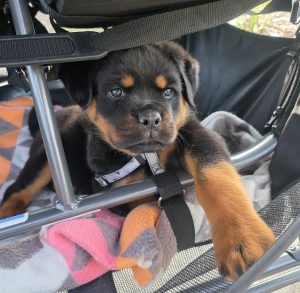
While long hikes are out, strolling around in the backyard with you is great. If no backyard, short, rambling walks are great. Let your puppy sniff, explore and take it at his own pace. You can use short training sessions in your walks to work on heeling/loose leash walking, but the majority of the time should be at your puppy’s own pace and discretion. If hiking, you could bring your puppy along – great socialization for puppies. But just like a small child on a walk, be prepared to carry your puppy a good portion of the way. If you’re jogging or walking on a manicured trail or paved park road, consider investing in a puppy stroller to put your pup in for most of the walk.
Soft Landings
Jumping of beds and couches are major causes of spiral fractures in puppies – we are constantly on guard until our puppies reach two years old and keep them off furniture and beds unless we’re there to help them off. Use heavy carpet pads and carpets around all furniture and beds to cushion impact, should a young (or old) dog slip by and get up on a high piece of furniture. You can start training in agility but no jumping higher than wrist height until 6 months old, no jumping higher than elbow height until 18 months old.
Stairs not great for young hips
A study of 500 Newfoundland, Labrador, and Leonberger puppies found that puppies who climbed flights of stairs daily before they were 3 months of age had an increased risk of developing hip dysplasia. Although climbing flights of stairs on a daily basis represents an inappropriate strain on puppy joints, doing one or two not-too-steep steps with a non-slip surface would not represent any risk to the puppy and may be a nice body awareness, coordination exercise.
Have fun with your Rottweiler puppy, but PLEASE play it safe.